Écoutez gratuitement ce podcast dans l'application : Télécharger gratuitement dans l'App Store
radio.fr
Minuteur
Sauvegarde des favoris
212 épisodes
211. Emma Heming Willis and Dr. Nicole Beurkens: Why Women Face a Higher Alzheimer's Risk—Menopause, Brain Fog & Prevention
27/10/2026 | 1 h 9 minWhat if the brain fog, forgetfulness, poor sleep, and mood changes so many women experience in midlife aren't just signs of getting older—but signals that their brains need more support?
Women account for nearly two-thirds of Alzheimer's cases, yet women's brain health has historically been overlooked in medical research and conversations about prevention. And as estrogen levels begin to change during perimenopause and menopause, those changes can affect everything from memory and mental clarity to metabolism, sleep, and emotional well-being.
In this episode, I'm joined by Emma Heming Willis, co-founder of Make Time Wellness, and Dr. Nicole Beurkens a clinical psychologist with a background in nutrition science, for an important conversation about women's brain health, hormonal changes, and what we can do today to support cognitive health as we age.
Emma shares her personal experience with brain fog, feeling dismissed by her doctor, and the lifestyle changes that inspired her mission to make brain health a priority for women. Together, we explore the science behind cognitive aging and the everyday habits that can make a meaningful difference.
In this episode, you'll learn:
Why women face a higher risk of Alzheimer's disease and dementia
How declining estrogen during perimenopause and menopause can affect memory, focus, and brain energy
Why brain fog, forgetfulness, and sleep disturbances deserve attention
How chronic stress, trauma, and the demands of caregiving can affect brain health
The connection between chronic inflammation, metabolic health, and cognitive function
Why nutrition, protein, fiber, and reducing ultra-processed foods matter for brain health
How sleep supports memory, cognitive performance, and long-term brain health
What to know about brain health supplements, including rhodiola, curcumin, and other nutrients
What the emerging research suggests about hormone replacement therapy and women's cognitive health
We also discuss practical ways to prioritize self-care, manage stress, improve sleep habits, and build sustainable routines without adding another overwhelming responsibility to an already busy life.
The biggest takeaway? Brain health shouldn't become a priority only when memory problems begin.
Protecting your brain is part of protecting your future. And the choices we make around sleep, nutrition, movement, stress, and hormonal health can help us take a more proactive approach to aging.
Because longevity isn't simply about living longer. It's about maintaining the clarity, independence, and quality of life that allow us to enjoy those extra years.
Learn more about Dr. Shah:
Website: drshah.com
Clinic: next-health.com
Instagram: @darshanshahmd and @extend_podcast
Learn more about Emma Heming Willis and Dr. Nicole Beurkens
Website: drbeurkens.com and emmahemingwillis.com
Instagram: @emmahemingwillis, @drnicolebeurkens and @maketimewellness
Try Make Time Wellness at maketimewellness.com, use code EXTEND20 at checkout for 20% off as a gift to our listeners! Also available at Target, Amazon, Ulta, The Vitamin Shoppe and Meijer.
Thank You to Our Sponsor!
Momentous: Head to livemomentous.com and use my code DRSHAH at checkout for up to 35% off.210. Dr. Rena Malik: Why Erectile Dysfunction Could Be an Early Warning Sign of Heart Disease
22/10/2026 | 1 h 6 minWhat if problems in the bedroom were actually an early warning sign of something much bigger happening in your body?
Most people think of sexual health as separate from their overall health. But erectile dysfunction, low libido, and changes in sexual performance can reveal important clues about cardiovascular health, hormone levels, metabolic function, and even how we're aging.
In this episode, I'm joined by Dr. Rena Malik, a urologist and sexual health expert, to explore why sexual health deserves a much bigger place in the longevity conversation. We discuss her concept of "sex span"—how long we can maintain a healthy, satisfying sex life—and why protecting it may also mean protecting our long-term health.
One of the most eye-opening parts of our conversation is the connection between erectile dysfunction and heart disease. Because the blood vessels involved in erections are smaller than those supplying the heart, vascular problems can sometimes appear as sexual dysfunction years before more serious cardiovascular symptoms develop.
We also break down the truth about testosterone replacement therapy (TRT), Viagra, Cialis, nitric oxide supplements, pelvic floor health, and the psychological factors that influence sexual performance.
In this episode, you'll learn:
Why erectile dysfunction can be an early warning sign of cardiovascular disease
The five major causes of erectile dysfunction—and why low testosterone isn't always the answer
How morning erections and nighttime erections can provide clues about sexual health
The difference between Viagra and Cialis, and what these medications actually do
What to know about testosterone replacement therapy, including its effects on fertility
Whether supplements like L-citrulline and L-arginine can improve erectile function
How pelvic floor health, exercise, sleep, and stress affect sexual performance
How pornography, masturbation, and performance anxiety can influence arousal
Why communication, intimacy, and relationship health matter for maintaining sexual wellness as we age
We also discuss emerging treatments for erectile dysfunction, the importance of identifying underlying health problems rather than simply treating symptoms, and the four pillars of sexual health Dr. Malik explores in her book, The Hard Truth.
The biggest takeaway? Sexual health isn't just about sex. It's another window into your overall health.
When we start treating sexual dysfunction as a potential signal of deeper metabolic, vascular, hormonal, or psychological issues, we create an opportunity to intervene earlier, improve quality of life, and potentially protect our long-term health.
Because longevity isn't just about adding years to your life. It's about preserving the health, connection, and vitality that make those years worth living.
Learn more about Dr. Shah:
Website: drshah.com
Clinic: next-health.com
Instagram: @darshanshahmd and @extend_podcast
Learn more about Dr. Rena Malik:
Webiste: renamalikmd.com
YouTube: youtube.com/@RenaMalikMD
Instagram: @renamalikmd
Book: renamalikmd.com/hardtruth
Thank You to Our Sponsors!
Next Health: Your destination for cutting-edge health optimization - from IV therapy to hormone balancing. Explore at next-health.com!
Momentous: Head to livemomentous.com and use my code DRSHAH at checkout for up to 35% off!209. Dr. David Barzilai: Can We Reverse Aging? Harvard's Latest Longevity Science Explained
20/10/2026 | 1 h 4 minWhat if aging isn't just something that happens to us—but a biological process we can actually influence?
For decades, medicine has focused on treating diseases after they develop. But a growing field called geroscience is asking a much bigger question: What if we could target the underlying biology of aging itself, potentially delaying multiple age-related diseases before they begin?
In this episode, I'm joined by Dr. David Barzilai, MD, PhD, MBA, longevity medicine physician, Harvard Medical School lecturer, and medical editor of Harvard's Pathways to Longevity special report, to explore the science of biological aging and what it could mean for the future of human health.
We break down the 12 hallmarks of aging, why your biological age may be different from your chronological age, and how researchers are developing new ways to measure and potentially influence how quickly we age.
From epigenetic age testing and telomeres to senescent cells, autophagy, rapamycin, and cellular reprogramming, we separate promising longevity science from the hype.
In this episode, you'll learn:
What the 12 hallmarks of aging reveal about why our bodies get older
The difference between biological age and chronological age—and whether aging can be slowed
How accurate biological age tests and epigenetic clocks really are
Why VO2 max, muscle strength, sleep, and metabolic health are powerful indicators of longevity
What telomeres reveal about cellular aging and why longer isn't always better
How senescent "zombie cells" contribute to age-related inflammation
What fasting, calorie restriction, and autophagy actually do inside your cells
What the research says about rapamycin, senolytics, and emerging longevity treatments
How cellular reprogramming and Yamanaka factors could change the future of regenerative medicine
We also discuss personalized longevity testing, the limitations of today's aging biomarkers, and emerging research exploring whether scientists could one day restore more youthful function to aging cells and tissues.
The most important takeaway? You don't have to wait for the next breakthrough to start improving how you age. Exercise, cardiovascular fitness, strength training, sleep, nutrition, and understanding your personal health risks remain some of the most powerful tools we have today.
The future of longevity medicine is incredibly exciting. But the real opportunity is combining what we already know works with the science that's still to come.
Learn more about Dr. Shah:
Website:drshah.com
Clinic: next-health.com
Instagram: @darshanshahmd and @extend_podcast
Learn more about Dr. David Barzilai:
Website: barzilaiconsulting.com LinkedIn: linkedin.com/in/agingdoc X (formerly Twitter): x.com/agingdoc1 Instagram: instagram.com/agingdoc1
Harvard Medical School's first Special Report on longevity, Pathways to Longevity, where I served as Medical Editor:
https://www.linkedin.com/posts/agingdoc_harvard-medical-school-has-just-published-ugcPost-7465326141025775616-GOnh
For further reading on longevity science and its clinical application, I'm Co-Editor of Frontiers of Longevity Science, forthcoming from Springer Nature:
https://www.barzilaiconsulting.com/fols
Thank You to Our Sponsors!
IM8: Try IM8 with a 30-day money back guarantee! Get 10% off your first order with code DRSHAH at im8health.com/drshah
Pendulum: Head to pendulumlife.com and use my code EXTEND for your first membership order!208. Dr. Thais Aliabadi: PCOS & Endometriosis—The Symptoms Women Should Never Ignore
15/10/2026 | 1 h 6 minWhat if the painful periods, irregular cycles, unexplained weight gain, acne, and fertility struggles so many women experience aren't something they should simply learn to live with?
Too often, women are told their symptoms are normal, their lab results look fine, or they're just stressed. But conditions like PCOS (polycystic ovary syndrome) and endometriosis can go unrecognized for years, leaving women without answers while their symptoms continue to affect their health and quality of life.
In this episode, I'm joined by Dr. Thais Aliabadi, her patients call her Dr. A, an OB-GYN with decades of experience in women's health, for an eye-opening conversation about two of the most commonly misunderstood conditions affecting women's hormones, metabolism, and reproductive health.
We break down the signs of PCOS and endometriosis, why these conditions are frequently overlooked, and how earlier recognition and individualized treatment can make a meaningful difference.
In this episode, you'll learn:
The warning signs of PCOS, including irregular periods, acne, facial hair, and unexplained weight changes
Why women can have PCOS even if they're lean or don't have ovarian cysts
How insulin resistance, testosterone, and inflammation are connected to PCOS
Why severe menstrual cramps and chronic pelvic pain deserve further investigation for endometriosis
How PCOS and endometriosis can affect ovulation, fertility, and ovarian health
What AMH testing can—and cannot—tell you about ovarian reserve
The roles of birth control, metformin, GLP-1 medications, and lifestyle changes in PCOS management
How endometriosis is evaluated and the treatment options available, from hormonal therapies to surgery
We also explore the connection between hormone health and mental well-being, the challenges women face when seeking a diagnosis, and why listening to patients is one of the most important parts of preventative medicine.
Your symptoms deserve to be taken seriously. Whether you're struggling with painful periods, irregular cycles, infertility, or unexplained hormonal changes, this conversation will help you better understand what may be happening in your body—and what questions to bring to your healthcare provider.
Learn more about Dr. Shah:
Website: drshah.com
Clinic: next-health.com
Instagram: @darshanshahmd and @extend_podcast
Learn more about Dr. Thais Aliabadi:
Website: draliabadi.com
Instagram: @drthaisaliabadi
Thank You to Our Sponsor!
Momentous: Head to livemomentous.com and use my code DRSHAH at checkout for up to 35% off.207. Dr. Jason Wersland: The Science of Recovery—Pain, HRV, Sleep & Your Nervous System
13/10/2026 | 54 minWe spend so much time thinking about exercise, nutrition, and performance—but I believe recovery may be one of the most overlooked pieces of longevity.
In this episode, I'm joined by Dr. Jason Wersland, chiropractor and founder of Therabody, whose own experience with debilitating pain after a motorcycle accident ultimately led him to invent the Theragun.
But this conversation goes far beyond muscle soreness.
Jason and I explore what recovery actually means, why it isn't just for athletes, and how the way we regulate our nervous system can influence pain, tension, sleep, performance, and how we feel every day. Whether you're training intensely, sitting at a desk for eight hours, standing all day at work, or simply dealing with chronic stress, your body still needs opportunities to recover.
In this episode, you'll learn:
• Why recovery should be part of your daily longevity routine—not just something you do after exercise
• How the "pain gate theory" helps explain why different forms of stimulation can temporarily change how we perceive pain
• Why sitting all day can contribute to hip, lower-back, neck, and shoulder tension
• How percussive therapy can affect pain, muscle tension, range of motion, and blood flow
• Why nervous system regulation matters for recovery and performance
• How shifting into a parasympathetic state may help you wind down before sleep
• Why HRV and heart rate can provide useful feedback about recovery
• How small "recovery snacks" throughout the day can help you take better care of your body
We also discuss massage, breathwork, movement, compression therapy, biofeedback, sleep, and practical ways to build short recovery "pit stops" into even the busiest schedule.
One of my biggest takeaways from this conversation is that recovery is not a luxury reserved for professional athletes. Your body is responding to physical, mental, and emotional stress every day. If we want to perform well—and stay healthy for decades—we have to give it opportunities to recover, too.
Learn more about Dr. Shah:
Website: drshah.com
Clinic: next-health.com
Instagram: @darshanshahmd and @extend_podcast
Learn more about Dr. Jason Wersland:
Website: therabody.com
Instagram: @drjasonwersland
Thank You to Our Sponsor:
IM8: Try IM8 with a 30 day money back guarantee. Get 10% off your first order with code DRSHAH at checkout im8health.com/drshah
Plus de podcasts Alimentation




Podcasts tendance de Alimentation



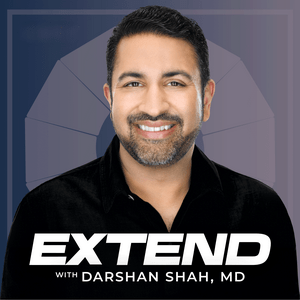
À propos de Extend Podcast with Darshan Shah, MD
Extend with Darshan Shah, MD is a podcast dedicated to cutting-edge science, research, tools, and protocols designed to help you extend your healthspan.
Starting my medical journey at 16 and becoming one of the youngest doctors in the country, studying and training at the Mayo Clinic, Harvard Business School, Singularity University and other prestigious institutions, becoming a board certified surgeon and accumulating over two decades of practice, I have discovered that a mere 20% of health knowledge yields 80% of the results.
That's why this podcast is all about cutting through the noise on how to turn back the aging clock.
I interview world-renowned medical practitioners, doctors, experts, and thought leaders, offering you a step-by-step guide and actionable advice to proactively avoid disease and optimize your health.
Plus, I share weekly solo episodes giving you quick, digestible protocols for successfully extending your healthspan.
Site web du podcastÉcoutez Extend Podcast with Darshan Shah, MD, Anthony Berthou ou d'autres podcasts du monde entier - avec l'app de radio.fr
Obtenez l’app radio.fr gratuite
- Ajout de radios et podcasts en favoris
- Diffusion via Wi-Fi ou Bluetooth
- Carplay & Android Auto compatibles
- Et encore plus de fonctionnalités
Obtenez l’app radio.fr gratuite
- Ajout de radios et podcasts en favoris
- Diffusion via Wi-Fi ou Bluetooth
- Carplay & Android Auto compatibles
- Et encore plus de fonctionnalités
Extend Podcast with Darshan Shah, MD
Scannez le code,
Téléchargez l’app,
Écoutez.
Téléchargez l’app,
Écoutez.
 France