Écoutez gratuitement ce podcast dans l'application : Télécharger gratuitement dans l'App Store
radio.fr
Minuteur
Sauvegarde des favoris
368 épisodes
Burned Out? Add GRAVY: Neurodivergent Recovery with Ryn Rising
26/10/2026 | 36 min"You're in graduate school."
"You're in a long-term relationship."
"You can carry a conversation."
Okay—but at what cost?
In this episode of Adulting with Autism, I talk with Ryn Rising, a queer, trans, neurodivergent counselor and coach who supports adults navigating late autism and ADHD identification, burnout, masking, identity, and relationships. Their practice offers counseling for Oregon residents and coaching for clients worldwide.
Ryn shares how burnout during graduate school led them to seek an autism assessment and reconsider an earlier bipolar diagnosis. We explore why being able to perform, achieve, or connect socially does not reveal how much effort that performance requires.
Ryn also introduces GRAVY: Gentleness, Rest and recovery, Accommodations, Vital needs, and Your joy. It is their personal framework for bringing more compassion, practical support, and recovery into a life where work, finances, and caregiving cannot simply disappear.
We talk about small changes, rebuilding self-trust, welcoming a client's "no," different processing needs in relationships, and Ryn's experience of moving abroad.
This conversation is for anyone who has finally found language for their experience—and is now asking, "How do I build a life that actually makes room for me?"
Content note: Discussion of mental-health misdiagnosis, medical harm, identity-related stress, and political concerns.
In This Episode, We Cover
p]:pt-0 [&>p]:mb-2 [&>p]:my-0"> Ryn's experience of burnout in high school and graduate school.
p]:pt-0 [&>p]:mb-2 [&>p]:my-0"> Moving from understimulation and extra commitments into overload.
p]:pt-0 [&>p]:mb-2 [&>p]:my-0"> Why they sought an autism assessment after an earlier diagnosis they describe as incorrect.
p]:pt-0 [&>p]:mb-2 [&>p]:my-0"> How late identification brought clarity and closure.
p]:pt-0 [&>p]:mb-2 [&>p]:my-0"> High masking and the hidden cost of appearing capable.
p]:pt-0 [&>p]:mb-2 [&>p]:my-0"> Why academic success and relationships do not tell the whole story of someone's support needs.
p]:pt-0 [&>p]:mb-2 [&>p]:my-0"> Exploring gendered expectations without reducing trans and nonbinary people to assumptions.
p]:pt-0 [&>p]:mb-2 [&>p]:my-0"> What self-erasure can look like in everyday decisions.
p]:pt-0 [&>p]:mb-2 [&>p]:my-0"> Rebuilding self-trust after years of overriding discomfort.
p]:pt-0 [&>p]:mb-2 [&>p]:my-0"> Accepting real constraints while identifying demands that can change.
p]:pt-0 [&>p]:mb-2 [&>p]:my-0"> The five parts of Ryn's GRAVY framework.
p]:pt-0 [&>p]:mb-2 [&>p]:my-0"> Taking micro-steps when a complete lifestyle overhaul is not possible.
p]:pt-0 [&>p]:mb-2 [&>p]:my-0"> Responding to the inner critic when a small step feels "not enough."
p]:pt-0 [&>p]:mb-2 [&>p]:my-0"> What lived experience can add to professional support.
p]:pt-0 [&>p]:mb-2 [&>p]:my-0"> Why no identity group is a monolith.
p]:pt-0 [&>p]:mb-2 [&>p]:my-0"> Making room for skepticism, disagreement, and refusal in therapy.
p]:pt-0 [&>p]:mb-2 [&>p]:my-0"> How Ryn distinguishes the emphasis of their therapy and coaching work.
p]:pt-0 [&>p]:mb-2 [&>p]:my-0"> Moving to the Netherlands and navigating identity across cultures.
p]:pt-0 [&>p]:mb-2 [&>p]:my-0"> Burnout during major life transitions.
p]:pt-0 [&>p]:mb-2 [&>p]:my-0"> Different processing times in relationships.
p]:pt-0 [&>p]:mb-2 [&>p]:my-0"> Pausing a difficult conversation without abandoning it.
p]:pt-0 [&>p]:mb-2 [&>p]:my-0"> Making room for joy after late-identification grief.
The GRAVY Framework
Ryn describes GRAVY as their own organizing framework, informed by approaches they use in therapy and coaching. It is not presented here as a separately validated treatment protocol.
:not([hidden])~:not([hidden]))]:border-soft">
:not([hidden])~:not([hidden]))]:border-soft bg-raised"> Letter Meaning Focus in the conversation G Gentleness Self-compassion, perfectionism, internalized ableism, and the inner critic R Rest and recovery Sleep, restorative rest, sensory recovery, and reducing demands A Accommodations Accessible routines, executive-function supports, sensory needs, and unmasking when safe V Vital needs Nutrition, hydration, and movement Y Your joy Special interests, play, connection, pleasure, and enjoyment
About the Guest
Ryn Rising, they/them, is a queer, trans, neurodivergent counselor and coach whose work focuses on late identification, burnout, masking exhaustion, identity exploration, life transitions, and relationships. Their approach combines professional training with lived experience and emphasizes collaboration, compassion, curiosity, and practical support.:not([hidden])~:not([hidden]))]:border-soft bg-soft">innerrising+1
Ryn's practice, Inner Rising Counseling and Coaching, offers online counseling for Oregon residents and coaching worldwide.
In this interview, they also discuss their move to the Netherlands and their planned podcast, The Human Therapist Rising, which they describe as a project about the humans behind therapeutic work.
Resources:
p]:pt-0 [&>p]:mb-2 [&>p]:my-0"> Inner Rising Counseling and Coaching.
p]:pt-0 [&>p]:mb-2 [&>p]:my-0"> Ryn's professional profile.psychologytoday
Publishing note: The interview names an earlier website, innerrisingwellness.com. The current site found for their practice is innerrising.nl.
Key Takeaways
p]:pt-0 [&>p]:mb-2 [&>p]:my-0"> Being able to do something does not reveal its emotional, sensory, or recovery cost.
p]:pt-0 [&>p]:mb-2 [&>p]:my-0"> Late identification can bring relief while also opening new questions about identity and daily life.
p]:pt-0 [&>p]:mb-2 [&>p]:my-0"> Self-trust can develop through noticing needs and responding to them in manageable ways.
p]:pt-0 [&>p]:mb-2 [&>p]:my-0"> Small changes deserve attention without being presented as a substitute for adequate resources or systemic support.
p]:pt-0 [&>p]:mb-2 [&>p]:my-0"> Joy belongs in a conversation about recovery—not only productivity and symptom management.
p]:pt-0 [&>p]:mb-2 [&>p]:my-0"> A client's disagreement is useful information, not automatically resistance.
p]:pt-0 [&>p]:mb-2 [&>p]:my-0"> Shared lived experience can support understanding without making two people's experiences identical.
p]:pt-0 [&>p]:mb-2 [&>p]:my-0"> Relationship conversations can make room for different processing needs without forcing an immediate agreement.From Demons to Champions: Learning to Love Your Neurodivergent Mind
24/10/2026 | 43 minWhat does helpful therapy look like when the goal is not simply more eye contact, fewer autistic traits, or appearing more comfortable than you actually feel?
In this episode of Adulting with Autism, I talk with autistic psychotherapist and author Sean Inderbitzen about feeling stuck, rumination, body awareness, connection, and the importance of having a real voice in your own care.
Sean introduces the approach he calls applied neural exercises: practices that invite curiosity and nonjudgmental attention to bodily experience. We discuss his use of polyvagal theory as a therapeutic framework, while exploring a broader question: what does this particular person want help with, and how will we know whether the support is working?
We also talk about masking in context, sensory environments, basic needs, and why an approach that helps one person may not fit another. During the conversation, I demonstrate the movement I use while interviewing—and we notice what happens when I pay attention to how it feels.
One of the most useful questions from the episode is one you can bring to a prospective therapist:
"How do you respond when a client tells you that you're wrong?"
Because support should include room to disagree, correct a misunderstanding, change direction, and say when something is not helping.
Content note: This conversation includes grief, trauma, and brief discussion of suicidal thoughts and a potentially distressing clinical example.
In This Episode, We Cover
p]:pt-0 [&>p]:mb-2 [&>p]:my-0"> Sean's experience as an autistic psychotherapist and author.
p]:pt-0 [&>p]:mb-2 [&>p]:my-0"> Why he wishes autism had been discussed more openly earlier in his life.
p]:pt-0 [&>p]:mb-2 [&>p]:my-0"> The personal vulnerability involved in writing about his own experience.
p]:pt-0 [&>p]:mb-2 [&>p]:my-0"> What he means by "neural exercises."
p]:pt-0 [&>p]:mb-2 [&>p]:my-0"> Flexibility and connection as individualized goals—not universal demands.
p]:pt-0 [&>p]:mb-2 [&>p]:my-0"> Looking at wellbeing across a person's relationship with themselves, close relationships, wider social life, and life overall.
p]:pt-0 [&>p]:mb-2 [&>p]:my-0"> Why the context of masking matters to the person making that choice.
p]:pt-0 [&>p]:mb-2 [&>p]:my-0"> Sean's explanation of polyvagal theory and how he applies it in therapy.
p]:pt-0 [&>p]:mb-2 [&>p]:my-0"> Exploring both internal distress and external conditions rather than assuming one explanation.
p]:pt-0 [&>p]:mb-2 [&>p]:my-0"> Food, sleep, shelter, sensory needs, and readiness for therapeutic work.
p]:pt-0 [&>p]:mb-2 [&>p]:my-0"> Approaching body awareness gradually when it feels difficult or overwhelming.
p]:pt-0 [&>p]:mb-2 [&>p]:my-0"> Stimming and movement as possible resources for noticing comfort, relaxation, or joy.
p]:pt-0 [&>p]:mb-2 [&>p]:my-0"> April's standing-and-swiveling interview setup.
p]:pt-0 [&>p]:mb-2 [&>p]:my-0"> Discussing rumination as an experience someone wants help with—not simply as a diagnostic label.
p]:pt-0 [&>p]:mb-2 [&>p]:my-0"> Feedback-informed treatment and asking whether sessions address the client's priorities.
p]:pt-0 [&>p]:mb-2 [&>p]:my-0"> What happens when a therapist's interpretation misses the mark.
p]:pt-0 [&>p]:mb-2 [&>p]:my-0"> Apologizing, repairing misunderstandings, and adjusting the work.
p]:pt-0 [&>p]:mb-2 [&>p]:my-0"> Questions to ask a prospective therapist about disagreement and feedback.
p]:pt-0 [&>p]:mb-2 [&>p]:my-0"> Supporting someone's regulation without trying to manage every aspect of their experience.
p]:pt-0 [&>p]:mb-2 [&>p]:my-0"> Using workbook exercises selectively while recognizing the role of their wider context.
About the Guest
Sean Inderbitzen is an autistic psychotherapist and author who writes for W. W. Norton about autism and applications of polyvagal theory. In this interview, he discusses Neural Exercises for Autism, his earlier work, and how personal experience has informed his approach to therapy.
His discussion emphasizes curiosity, the therapeutic relationship, client feedback, and exploring what supports a person's wellbeing in their own circumstances. He describes applied neural exercises as tools for bringing mindful attention to bodily experience and exploring flexibility and connection.
Sean directs listeners to his books through major retailers and to Instagram and LinkedIn to follow his work or ask questions. Search his name as Sean Inderbitzen; confirm exact profile links before adding them to the published show notes.
Key Takeaways
p]:pt-0 [&>p]:mb-2 [&>p]:my-0"> Progress should relate to the person's own goals—not automatically to appearing less autistic.
p]:pt-0 [&>p]:mb-2 [&>p]:my-0"> A supportive therapeutic relationship leaves room for correction and disagreement.
p]:pt-0 [&>p]:mb-2 [&>p]:my-0"> Body-awareness practices should be approached with attention to comfort, choice, and pacing.
p]:pt-0 [&>p]:mb-2 [&>p]:my-0"> Movement someone already enjoys can be a starting point for noticing what feels helpful.
p]:pt-0 [&>p]:mb-2 [&>p]:my-0"> Sensory conditions and basic needs belong in conversations about distress.
p]:pt-0 [&>p]:mb-2 [&>p]:my-0"> A therapist's personal experience is not a substitute for understanding the client's experience.
p]:pt-0 [&>p]:mb-2 [&>p]:my-0"> Repair includes acknowledging when an interpretation was invalidating and changing course.
p]:pt-0 [&>p]:mb-2 [&>p]:my-0"> Tools are possibilities to explore—not promises that every person will respond the same way
Connect with Gary Coulton
Continue the conversation about neurodivergence, self-understanding, and everyday wisdom:
p]:pt-0 [&>p]:mb-2 [&>p]:my-0"> The Positive Echo on Substack — Gary's weekly essays on making wiser decisions a little more often.
p]:pt-0 [&>p]:mb-2 [&>p]:my-0"> Gary on LinkedIn — Writing and conversations about wisdom, neurodivergence, clarity, and purpose.
p]:pt-0 [&>p]:mb-2 [&>p]:my-0"> Gary's author website — His background, memoir, and reader reflections.
Gary's Books
Wisdomize: See Clearly. Decide Wisely. Live Fully.
"A self-help book for people who hate being told what to do."
Gary describes Wisdomize as a concise, practical guide for reflective adults who want to think more clearly, connect with their values, and make decisions with greater purpose and integrity.
Rather than prescribing one correct way to live, the book offers invitations to reflect, notice, and explore your own responses.
Available for preorder from October 12, 2026, according to Gary's supplied promotional information.
Explore or preorder Wisdomize
Reader endorsement supplied by Gary:
"What I really like about Wisdomize is that it's not just another book telling you how to improve yourself. It actually gives you practical tools and exercises to help you reflect, make better decisions and take ownership of your own personal development."
— Owen Williams, Co-Founder of Six Red Squares
Demons to Champions: How I Fell in Love with My Neurodivergent Maverick Mind
Gary's memoir explores his internal and external worlds: professional achievement, feeling different, self-criticism, relationships, and learning to understand his neurodivergent mind. He describes it as a book for misfits and left-field thinkers—and for the people who love, work with, or lead them.garycoulton.co
Explore Demons to Champions
A reader's reflection:
"A compelling read, a beautifully written book which made me laugh and cry."
— Reader review featured on Gary's author website.garycoulton.co
Updated Episode Description Closing
Continue exploring the ideas from this conversation through Gary's memoir, Demons to Champions: How I Fell in Love with My Neurodivergent Maverick Mind, and his practical guide, Wisdomize: See Clearly. Decide Wisely. Live Fully.
For weekly reflections on making wiser decisions, visit The Positive Echo on Substack. Direct links to Gary's books, website, and LinkedIn are in the show notes.
You do not need another voice telling you everything you should be doing.
Gary Coulton's Wisdomize takes a different approach: practical reflection, everyday noticing, and questions that help you explore what matters to you.
His memoir, Demons to Champions, shares the personal journey behind that work—from self-criticism toward a kinder relationship with his neurodivergent mind.
📖 Wisdomize: https://mybook.to/wisdomize
📖 Demons to Champions: https://mybook.to/demonstochampions
✍️ The Positive Echo: https://garycoulton.substack.com/Can You Tell Your Therapist They're Wrong? Autism & Therapy with Sean Inderbitzen
21/10/2026 | 40 minWhat does helpful therapy look like when the goal is not simply more eye contact, fewer autistic traits, or appearing more comfortable than you actually feel?
In this episode of Adulting with Autism, I talk with autistic psychotherapist and author Sean Inderbitzen about feeling stuck, rumination, body awareness, connection, and the importance of having a real voice in your own care.
Sean introduces the approach he calls applied neural exercises: practices that invite curiosity and nonjudgmental attention to bodily experience. We discuss his use of polyvagal theory as a therapeutic framework, while exploring a broader question: what does this particular person want help with, and how will we know whether the support is working?
We also talk about masking in context, sensory environments, basic needs, and why an approach that helps one person may not fit another. During the conversation, I demonstrate the movement I use while interviewing—and we notice what happens when I pay attention to how it feels.
One of the most useful questions from the episode is one you can bring to a prospective therapist:
"How do you respond when a client tells you that you're wrong?"
Because support should include room to disagree, correct a misunderstanding, change direction, and say when something is not helping.
Content note: This conversation includes grief, trauma, and brief discussion of suicidal thoughts and a potentially distressing clinical example.
In This Episode, We Cover
p]:pt-0 [&>p]:mb-2 [&>p]:my-0"> Sean's experience as an autistic psychotherapist and author.
p]:pt-0 [&>p]:mb-2 [&>p]:my-0"> Why he wishes autism had been discussed more openly earlier in his life.
p]:pt-0 [&>p]:mb-2 [&>p]:my-0"> The personal vulnerability involved in writing about his own experience.
p]:pt-0 [&>p]:mb-2 [&>p]:my-0"> What he means by "neural exercises."
p]:pt-0 [&>p]:mb-2 [&>p]:my-0"> Flexibility and connection as individualized goals—not universal demands.
p]:pt-0 [&>p]:mb-2 [&>p]:my-0"> Looking at wellbeing across a person's relationship with themselves, close relationships, wider social life, and life overall.
p]:pt-0 [&>p]:mb-2 [&>p]:my-0"> Why the context of masking matters to the person making that choice.
p]:pt-0 [&>p]:mb-2 [&>p]:my-0"> Sean's explanation of polyvagal theory and how he applies it in therapy.
p]:pt-0 [&>p]:mb-2 [&>p]:my-0"> Exploring both internal distress and external conditions rather than assuming one explanation.
p]:pt-0 [&>p]:mb-2 [&>p]:my-0"> Food, sleep, shelter, sensory needs, and readiness for therapeutic work.
p]:pt-0 [&>p]:mb-2 [&>p]:my-0"> Approaching body awareness gradually when it feels difficult or overwhelming.
p]:pt-0 [&>p]:mb-2 [&>p]:my-0"> Stimming and movement as possible resources for noticing comfort, relaxation, or joy.
p]:pt-0 [&>p]:mb-2 [&>p]:my-0"> April's standing-and-swiveling interview setup.
p]:pt-0 [&>p]:mb-2 [&>p]:my-0"> Discussing rumination as an experience someone wants help with—not simply as a diagnostic label.
p]:pt-0 [&>p]:mb-2 [&>p]:my-0"> Feedback-informed treatment and asking whether sessions address the client's priorities.
p]:pt-0 [&>p]:mb-2 [&>p]:my-0"> What happens when a therapist's interpretation misses the mark.
p]:pt-0 [&>p]:mb-2 [&>p]:my-0"> Apologizing, repairing misunderstandings, and adjusting the work.
p]:pt-0 [&>p]:mb-2 [&>p]:my-0"> Questions to ask a prospective therapist about disagreement and feedback.
p]:pt-0 [&>p]:mb-2 [&>p]:my-0"> Supporting someone's regulation without trying to manage every aspect of their experience.
p]:pt-0 [&>p]:mb-2 [&>p]:my-0"> Using workbook exercises selectively while recognizing the role of their wider context.
About the Guest
Sean Inderbitzen is an autistic psychotherapist and author who writes for W. W. Norton about autism and applications of polyvagal theory. In this interview, he discusses Neural Exercises for Autism, his earlier work, and how personal experience has informed his approach to therapy.
His discussion emphasizes curiosity, the therapeutic relationship, client feedback, and exploring what supports a person's wellbeing in their own circumstances. He describes applied neural exercises as tools for bringing mindful attention to bodily experience and exploring flexibility and connection.
Sean directs listeners to his books through major retailers and to Instagram and LinkedIn to follow his work or ask questions. Search his name as Sean Inderbitzen; confirm exact profile links before adding them to the published show notes.
Key Takeaways
p]:pt-0 [&>p]:mb-2 [&>p]:my-0"> Progress should relate to the person's own goals—not automatically to appearing less autistic.
p]:pt-0 [&>p]:mb-2 [&>p]:my-0"> A supportive therapeutic relationship leaves room for correction and disagreement.
p]:pt-0 [&>p]:mb-2 [&>p]:my-0"> Body-awareness practices should be approached with attention to comfort, choice, and pacing.
p]:pt-0 [&>p]:mb-2 [&>p]:my-0"> Movement someone already enjoys can be a starting point for noticing what feels helpful.
p]:pt-0 [&>p]:mb-2 [&>p]:my-0"> Sensory conditions and basic needs belong in conversations about distress.
p]:pt-0 [&>p]:mb-2 [&>p]:my-0"> A therapist's personal experience is not a substitute for understanding the client's experience.
p]:pt-0 [&>p]:mb-2 [&>p]:my-0"> Repair includes acknowledging when an interpretation was invalidating and changing course.
p]:pt-0 [&>p]:mb-2 [&>p]:my-0"> Tools are possibilities to explore—not promises that every person will respond the same waYou Don't Need a Business Degree to Start: Neurodivergent Entrepreneurship
19/10/2026 | 25 minI thought I would spend my career treating patients, become a director of rehab, and eventually retire.
Apparently, life had other plans.
In this solo episode of Adulting with Autism, I'm sharing what I have learned about becoming an entrepreneur while working full-time as an occupational therapist—and why you do not need a business degree or a perfect plan before you explore an idea.
I started this podcast because I was frustrated by the lack of resources for my autistic son as he entered adulthood. I knew the problem I wanted to address. Running a podcast as a business? That part I had to learn.
We're talking about doing too much, trying to be on every platform, buying equipment before you need it, comparing yourself to established creators, setting interview boundaries, and figuring out which services are actually worth paying for.
I also share how I use ChatGPT—yes, her name is Shonda—to organize ideas and support my workflow, along with the deeply unfortunate moment I copied our entire conversation into a professional email.
Including the profanity.
This is not a blueprint for overnight success. It is an honest look at starting small, making mistakes, protecting your capacity, asking questions, and building systems that help you function instead of just making you look productive.
In This Episode, We Cover
p]:pt-0 [&>p]:mb-2 [&>p]:my-0"> Why my original career plan did not include becoming a podcast entrepreneur.
p]:pt-0 [&>p]:mb-2 [&>p]:my-0"> Starting Adulting with Autism to address a need I experienced as a parent.
p]:pt-0 [&>p]:mb-2 [&>p]:my-0"> Learning business skills after launching rather than waiting to know everything.
p]:pt-0 [&>p]:mb-2 [&>p]:my-0"> Why publishing a podcast and helping people discover it are different jobs.
p]:pt-0 [&>p]:mb-2 [&>p]:my-0"> Building an episode catalog and improving through practice.
p]:pt-0 [&>p]:mb-2 [&>p]:my-0"> Figuring out where your audience spends time.
p]:pt-0 [&>p]:mb-2 [&>p]:my-0"> Trying Facebook, Instagram, TikTok, YouTube, blogs—and handmade T-shirts—while working full-time.
p]:pt-0 [&>p]:mb-2 [&>p]:my-0"> How doing too much can turn meaningful work into another obligation.
p]:pt-0 [&>p]:mb-2 [&>p]:my-0"> Starting with available equipment and upgrading within your budget.
p]:pt-0 [&>p]:mb-2 [&>p]:my-0"> Comparing your early-stage project with someone else's established platform.
p]:pt-0 [&>p]:mb-2 [&>p]:my-0"> Rejection, guest outreach, connections, and opportunities that take time.
p]:pt-0 [&>p]:mb-2 [&>p]:my-0"> How I use AI for guest research, interview preparation, organization, and brainstorming.
p]:pt-0 [&>p]:mb-2 [&>p]:my-0"> Why AI output still needs review and verification.
p]:pt-0 [&>p]:mb-2 [&>p]:my-0"> The copy-and-paste email mistake I will never forget.
p]:pt-0 [&>p]:mb-2 [&>p]:my-0"> Interview limits, weekend boundaries, and protecting my social battery.
p]:pt-0 [&>p]:mb-2 [&>p]:my-0"> Recognizing that loving the work does not make it cost-free.
p]:pt-0 [&>p]:mb-2 [&>p]:my-0"> Changing systems when they stop working.
p]:pt-0 [&>p]:mb-2 [&>p]:my-0"> Learning about business expenses, cash flow, taxes, contracts, and paid support.
p]:pt-0 [&>p]:mb-2 [&>p]:my-0"> Asking questions and choosing learning methods you can actually use.
p]:pt-0 [&>p]:mb-2 [&>p]:my-0"> Giving yourself permission to build something imperfect.
About the Host
April Ratchford, MS, OT/L, is an autistic occupational therapist, parent of an autistic young adult, and host of Adulting with Autism.
She launched the podcast on January 1, 2024, after struggling to find relevant resources for her son's transition into adulthood. Through interviews and solo episodes, April shares conversations about work, healthcare, relationships, executive function, self-advocacy, community, and everyday adult life.
In this episode, she discusses the business side of that work: building an audience, managing a growing workload, using tools, making financial decisions, and developing more sustainable boundaries while continuing in direct patient care.
Connect:
p]:pt-0 [&>p]:mb-2 [&>p]:my-0"> Website: adultingwithautism.com
p]:pt-0 [&>p]:mb-2 [&>p]:my-0"> Email: adultingwithautism.podcast@outlook.com
p]:pt-0 [&>p]:mb-2 [&>p]:my-0"> Social links and direct messages: available through the website.
Key Takeaways
p]:pt-0 [&>p]:mb-2 [&>p]:my-0"> You can begin exploring a business idea without knowing every part of business management.
p]:pt-0 [&>p]:mb-2 [&>p]:my-0"> Knowing who you want to serve gives you a useful starting point.
p]:pt-0 [&>p]:mb-2 [&>p]:my-0"> A limited budget is a reason to make deliberate choices—not to buy a professional-looking setup before testing the idea.
p]:pt-0 [&>p]:mb-2 [&>p]:my-0"> Being everywhere can become more work than your capacity allows.
p]:pt-0 [&>p]:mb-2 [&>p]:my-0"> AI can support a workflow, but reviewing its output remains your responsibility.
p]:pt-0 [&>p]:mb-2 [&>p]:my-0"> Business income and money available for personal spending are not the same thing.
p]:pt-0 [&>p]:mb-2 [&>p]:my-0"> Enjoying your work does not eliminate your need for rest.
p]:pt-0 [&>p]:mb-2 [&>p]:my-0"> Systems can change as your responsibilities, capacity, and business change.
p]:pt-0 [&>p]:mb-2 [&>p]:my-0"> Mistakes can become lessons without becoming a permanent judgment about your ability.
p]:pt-0 [&>p]:mb-2 [&>p]:my-0"> Starting small and asking questions count as doing the work.Autistic Adults Deserve Relationship Education: Consent, Dating & Boundaries
17/10/2026 | 26 minAutistic children become autistic adults.
But who explains friendship, attraction, changing relationships, consent, sensory preferences, and boundaries when so much support still focuses on childhood?
In this episode of Adulting with Autism, I talk with Trishta Villalta, a Board Certified Behavior Analyst and creator of Capable Hearts, a friendship and dating platform for adults with optional coaching support. The platform describes its mission as helping adults connect while maintaining choice over who they speak with and what they share.
Trishta shares how supporting a client from childhood into adulthood revealed gaps in relationship education. We discuss direct ways to express interest, ask whether someone wants to meet again, communicate touch preferences, and clarify misunderstandings without assuming every interaction should follow a neurotypical script.
We also explore ongoing consent, pressure versus disappointment, protecting alone time, and what it means for adult coaching to follow the person's own goals—including their right to change direction or stop.
This episode is for autistic adults seeking friendship or dating, partners, families, and professionals who want relationship support to respect autonomy rather than reward compliance.
In This Episode, We Cover
p]:pt-0 [&>p]:mb-2 [&>p]:my-0"> Why Trishta chose to develop support for adults alongside her work with children.
p]:pt-0 [&>p]:mb-2 [&>p]:my-0"> The problem with viewing autistic people as "forever children."
p]:pt-0 [&>p]:mb-2 [&>p]:my-0"> Relationship questions that can remain unanswered when adults assume someone already understands.
p]:pt-0 [&>p]:mb-2 [&>p]:my-0"> Why withholding information about sexual health and boundaries is not the same as protecting someone.
p]:pt-0 [&>p]:mb-2 [&>p]:my-0"> Adult-directed coaching: working on the goals a person chooses.
p]:pt-0 [&>p]:mb-2 [&>p]:my-0"> The difference between communication support and pressure to perform a different social identity.
p]:pt-0 [&>p]:mb-2 [&>p]:my-0"> Asking directly whether someone wants to keep talking or meet again.
p]:pt-0 [&>p]:mb-2 [&>p]:my-0"> Expressing romantic interest without relying only on hints.
p]:pt-0 [&>p]:mb-2 [&>p]:my-0"> Clarifying meaning and apologizing after an unintended hurtful comment.
p]:pt-0 [&>p]:mb-2 [&>p]:my-0"> Navigating uncertainty without repeatedly seeking reassurance.
p]:pt-0 [&>p]:mb-2 [&>p]:my-0"> Choosing meeting locations around both people's sensory preferences.
p]:pt-0 [&>p]:mb-2 [&>p]:my-0"> Discussing touch, textures, sounds, and personal space.
p]:pt-0 [&>p]:mb-2 [&>p]:my-0"> Consent as an ongoing conversation—not permanent permission.
p]:pt-0 [&>p]:mb-2 [&>p]:my-0"> Recognizing discomfort and pausing when someone appears unsure.
p]:pt-0 [&>p]:mb-2 [&>p]:my-0"> Pressure, guilt, fear of losing a relationship, and the right to refuse.
p]:pt-0 [&>p]:mb-2 [&>p]:my-0"> Capable Hearts' friendship/dating features and separate coaching options.
p]:pt-0 [&>p]:mb-2 [&>p]:my-0"> Trishta's description of reporting and blocking within the app.
p]:pt-0 [&>p]:mb-2 [&>p]:my-0"> Respecting an adult's right to decline coaching or change their goals.
p]:pt-0 [&>p]:mb-2 [&>p]:my-0"> Communicating a need for alone time and recovery after work or school.
About the Guest
Trishta Villalta is a Board Certified Behavior Analyst who says she has held the credential since approximately 2018. In this interview, she describes how her experience supporting clients into adulthood led her to create Capable Hearts.
Capable Hearts is an adults-only friendship and dating platform with optional BCBA coaching. Its website describes features including profiles, accessibility preferences, reporting, privacy controls, and opportunities to develop social connections.
Trishta's stated approach to adult coaching centers on what the individual wants to work on, rather than having the professional choose goals on their behalf.
Find the platform and contact information at capablehearts.com.
Contact email listed on the website: trishta@capablehearts.com.
Key Takeaways
p]:pt-0 [&>p]:mb-2 [&>p]:my-0"> Autistic adults deserve clear, respectful relationship education—not assumptions that they are uninterested or already know everything.
p]:pt-0 [&>p]:mb-2 [&>p]:my-0"> Direct questions can make intentions clearer, although another person may still respond ambiguously.
p]:pt-0 [&>p]:mb-2 [&>p]:my-0"> Friendship, dating, physical affection, and coaching are separate choices.
p]:pt-0 [&>p]:mb-2 [&>p]:my-0"> Someone can enjoy your company without wanting touch, romance, or sexual contact.
p]:pt-0 [&>p]:mb-2 [&>p]:my-0"> A boundary does not need an elaborate explanation to deserve respect.
p]:pt-0 [&>p]:mb-2 [&>p]:my-0"> Consent can change. Silence, freezing, or uncertainty should not be treated as permission.
p]:pt-0 [&>p]:mb-2 [&>p]:my-0"> Another person's disappointment does not create an obligation to agree.
p]:pt-0 [&>p]:mb-2 [&>p]:my-0"> Adult support should leave room for refusal, revised goals, and stopping.
p]:pt-0 [&>p]:mb-2 [&>p]:my-0"> Needing quiet or time alone is compatible with wanting connection.
Plus de podcasts Forme et santé









Podcasts tendance de Forme et santé






























À propos de Adulting with Autism
ADULTING WITH AUTISM
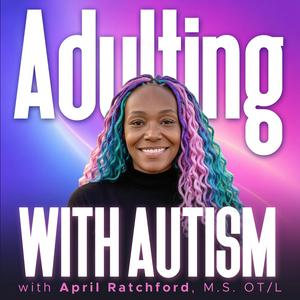
A movement for neurodivergent adults, created by autistic occupational therapist April Ratchford, OTR/L.
Adulting with Autism is a global community for autistic and ADHD adults navigating independence, relationships, college life, careers, emotional regulation, and real-world executive-function challenges. With over 2.7 million downloads, April blends lived experience, clinical insight, and honest conversation to guide neurodivergent adults into their next chapter of growth.
Each episode brings practical tools, mental-health strategies, autistic storytelling, and real talk about boundaries, burnout, sensory needs, finances, friendships, and the messy parts of becoming an independent adult.
Featuring leading experts in autism, mental health, neuroscience, accessibility, and creative industries — along with deeply human stories from autistic adults around the world.
If you're a late-diagnosed autistic adult, a college student trying to survive executive-function chaos, or a neurodivergent person trying to build a life that actually fits — you are in the right place.
🎙️ Hosted by:
April Ratchford, OTR/L — autistic occupational therapist, autism advocate, author, and executive contributor to Brainz Magazine.
Site web du podcastÉcoutez Adulting with Autism, La méthode du bonheur ou d'autres podcasts du monde entier - avec l'app de radio.fr
Obtenez l’app radio.fr gratuite
- Ajout de radios et podcasts en favoris
- Diffusion via Wi-Fi ou Bluetooth
- Carplay & Android Auto compatibles
- Et encore plus de fonctionnalités
Obtenez l’app radio.fr gratuite
- Ajout de radios et podcasts en favoris
- Diffusion via Wi-Fi ou Bluetooth
- Carplay & Android Auto compatibles
- Et encore plus de fonctionnalités

Adulting with Autism
Scannez le code,
Téléchargez l’app,
Écoutez.
Téléchargez l’app,
Écoutez.
 France