

Écoutez gratuitement ce podcast dans l'application : Télécharger gratuitement dans l'App Store
radio.fr
Minuteur
Sauvegarde des favoris
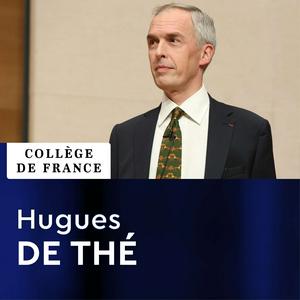
Oncologie cellulaire et moléculaire - Hugues de Thé
Collège de France
Dernier épisode
62 épisodes
Colloque - Oxidative Stress in Cancer-Therapy Response: The KEAP1-NRF2 Pathway: From Molecular Stress Sensor to Human Disease
29/05/2026 | 53 minHugues de Thé
Collège de France
Oncologie cellulaire et moléculaire
Année 2025-2026
Colloque - Oxidative Stress in Cancer-Therapy Response:
The KEAP1-NRF2 Pathway: From Molecular Stress Sensor to Human Disease
Masayuki Yamamoto
Tohoku University Graduate School of Medicine, Tohoku Medical Megabank Organization, Sendai, JaponColloque - Oxidative Stress in Cancer-Therapy Response: From Oxidative Stress to Stem Cell Dysfunction: The Impact of Low-Dose Irradiation on Hematopoietic Stem Cells
29/05/2026 | 21 minHugues de Thé
Collège de France
Oncologie cellulaire et moléculaire
Année 2025-2026
Colloque - Oxidative Stress in Cancer-Therapy Response:
From Oxidative Stress to Stem Cell Dysfunction: The Impact of Low-Dose Irradiation on Hematopoietic Stem Cells
Nathalie Gault
CEA, Direction de la Recherche Fondamentale, Institut de Biologie François Jacob - Laboratoire d'Étude de la Niche, du Cancer et des Radiations dans l'Hématopoïèse, Fontenay aux Roses, FranceColloque - Oxidative Stress in Cancer-Therapy Response: Chemical Control of Cell Adaptation
29/05/2026 | 35 minHugues de Thé
Collège de France
Oncologie cellulaire et moléculaire
Année 2025-2026
Colloque - Oxidative Stress in Cancer-Therapy Response:
Chemical Control of Cell Adaptation
Raphaël Rodriguez
Institut Curie, Paris, FranceColloque - Oxidative Stress in Cancer-Therapy Response: The Multifaceted Roles of Oxidative Stress in Health and Disease
29/05/2026 | 1 h 6 minHugues de Thé
Collège de France
Oncologie cellulaire et moléculaire
Année 2025-2026
Colloque - Oxidative Stress in Cancer-Therapy Response:
The Multifaceted Roles of Oxidative Stress in Health and Disease
Helmut Sies
Institute for Biochemistry and Molecular Biology I, Medical Faculty, Heinrich Heine University Düsseldorf, Allemagne04 - Stress oxydant et thérapeutiques anti-tumorales : Le cas de la ferroptose
26/11/2025 | 1 h 18 minHugues de Thé
Collège de France
Oncologie cellulaire et moléculaire
Année 2025-2026
04 - Stress oxydant et thérapeutiques anti-tumorales : Le cas de la ferroptose
Plus de podcasts Science de la vie
 Les VolontairesScience de la vie, Sciences
 Dynamiques du vivant - Thomas LecuitScience de la vie, Sciences
 Les voies métaboliquesScience de la vie, Sciences
 Paléoanthropologie du genre Homo - Jean-Jacques HublinScience de la vie, Sciences
 40 ans de biologie au service de l’Histoire, par OzymeForme et santé, Médecine, Science de la vie, Sciences, Sciences naturelles
 Psychologie cognitive expérimentale - Stanislas DehaeneScience de la vie, Sciences
 Speaking of PsychologyForme et santé, Santé mentale, Science de la vie, Sciences
- Oncologie cellulaire et moléculaire - Hugues de ThéScience de la vie, Sciences
 Reinvent Yourself with Dr. TaraForme et santé, Religion et spiritualité, Santé mentale, Science de la vie, Sciences, Spiritualité
 Short WaveActualités, Science de la vie, Sciences
Podcasts tendance de Science de la vie
 Accès au Marché Mondial des Dispositifs MédicauxBusiness, Science de la vie, Sciences, Technologies
- Dynamiques du vivant - Thomas LecuitScience de la vie, Sciences
- Reinvent Yourself with Dr. TaraForme et santé, Religion et spiritualité, Santé mentale, Science de la vie, Sciences, Spiritualité
- Oncologie cellulaire et moléculaire - Hugues de ThéScience de la vie, Sciences
- Les VolontairesScience de la vie, Sciences
 Raising HealthScience de la vie, Sciences, Technologies
 پادکست اتاق تراپی | The Therapy RoomDéveloppement personnel, Forme et santé, Santé mentale, Science de la vie, Sciences, Éducation
- Speaking of PsychologyForme et santé, Santé mentale, Science de la vie, Sciences
À propos de Oncologie cellulaire et moléculaire - Hugues de Thé
L'oncologie est l'approche biologique de la transformation cancéreuse des cellules. Née il y a environ deux cents ans, avec des approches morphologiques, elle a connu une accélération brutale depuis quelques décennies, avec la découverte du répertoire des anomalies génétiques – le plus souvent acquises – qui déclenchent la maladie. De nombreuses autres branches de la biologie (épigénétique, immunologie, biologie cellulaire, interactions cellulaires...) sont venues enrichir la discipline. Les premières années d'enseignement de la chaire ont été consacrées à une approche historique, partant du rôle des virus, de celui du contrôle de l'expression génétique par des « gènes maîtres », jusqu'aux liens entre hormones et cancers. Les dernières années, nous avons traité les rapports entre cancers et différenciation ou cancer et sénescence, une forme de réponse cellulaire au stress impliqué dans la défense contre la transformation cancéreuse, comme dans la réponse thérapeutique. Nous entamons maintenant un nouveau cycle dédié à une étude renouvelée du mode d'action cellulaire et moléculaire des agents anti-cancéreux conventionnels ou historiques. Ces questions sont centrales pour la compréhension de la réponse aux différents traitements utilisés en clinique.RechercheL'un des fils conducteurs de notre activité de recherche est l'exploration des bases cellulaires à la réponse aux traitements anticancéreux chez l'homme. Le modèle de prédilection étudié par l'équipe est une forme rare de leucémie, liée à une anomalie génétique simple et associée à l'extrême sensibilité à des agents thérapeutiques dépourvus d'activité dans d'autres formes de cancers : une hormone (acide rétinoïque) et un toxique (l'oxyde d'arsenic). Nous avons pu montrer que ces deux agents ciblent directement la protéine à l'origine du déclenchement de cette forme particulière de leucémie et induisent la dégradation de cette protéine maîtresse. Les mécanismes biochimiques et cellulaires associés à la réponse thérapeutique ont été caractérisés. Élucider les bases moléculaires de la réponse thérapeutique nous semble essentiel, car sans compréhension fine des mécanismes, il n'y a pas d'optimisation possible. Nous étudions également les bases biologiques de l'activité de l'actinomycine D, et plus généralement celles des antibiotiques anticancéreux.Ces études nous ont conduits à nous intéresser à des sous-domaines du noyau cellulaire, les corps nucléaires PML, qui sont associés à la réponse au stress et à la sénescence. L'équipe de recherche, avec V. Lallemand-Breitenbach, directeur de recherche Inserm, cherche à élucider la formation, le rôle biochimique et physiologique de ces domaines dans des situations normales ou pathologiques (voir site du CIRB).BiographieNé le 18 janvier 1959, à Marseille.Hugues de Thé a bénéficié d'une double formation médicale et scientifique. Il explore les relations entre transcription des gènes, architecture du noyau et développement des cancers. Après la découverte d'un récepteur à l'acide rétinoïque et du premier élément de réponse à cette hormone lors de sa thèse dans le laboratoire de Pierre Tiollais à l'Institut Pasteur, il a apporté une contribution clef à la caractérisation de PML/RARA, le gène à l'origine de la leucémie aiguë promyélocytaire (LAP).Il s'est depuis entièrement consacré à la compréhension de l'action de la protéine synthétisée par ce gène, montrant que PML/RARA exerce des effets dominants négatifs aussi bien sur la régulation de la transcription que sur l'organisation des corps nucléaires PML. Il a montré que les deux médicaments actifs dans la LAP, l'arsenic et l'acide rétinoïque, induisent tous deux la dégradation de la protéine PML/RARA, l'arsenic ciblant sa partie PML et l'acide rétinoïque sa partie RARA.Utilisant des modèles animaux de cette leucémie, il a pu démontrer que l'induction de la dégradation de PML/RARA par l'acide rétinoïque ou l'arsenic est bien à l'origine de leurs bénéfices cliniques et que la combinaison de ces deux agents guérit définitivement la maladie par un mécanisme impliquant la reformation des corps PML et l'activation du suppresseur de tumeur P53. Des essais cliniques directement inspirés de ses travaux ont conduit à la guérison définitive de la quasi-totalité des patients, faisant de la LAP le premier exemple d'une leucémie guérie par des traitements ciblés.Partant du modèle de la LAP, il a apporté des éclairages originaux sur des problématiques très fondamentales de biologie cellulaire, comme l'assemblage des corps nucléaires PML, ou de biochimie, comme le couplage sumoylation/ ubiquitination/ dégradation des protéines.Ses travaux actuels cherchent à élucider les mécanismes moléculaires de réponses aux traitements anticancéreux, ainsi qu'à explorer, d'autres formes de leucémies, le rôle de PML dans la réponse thérapeutique ou les relations entre surexpression de RARA et immortalisation des progéniteurs.
Site web du podcastÉcoutez Oncologie cellulaire et moléculaire - Hugues de Thé, Les Volontaires ou d'autres podcasts du monde entier - avec l'app de radio.fr
Obtenez l’app radio.fr gratuite
- Ajout de radios et podcasts en favoris
- Diffusion via Wi-Fi ou Bluetooth
- Carplay & Android Auto compatibles
- Et encore plus de fonctionnalités
Obtenez l’app radio.fr gratuite
- Ajout de radios et podcasts en favoris
- Diffusion via Wi-Fi ou Bluetooth
- Carplay & Android Auto compatibles
- Et encore plus de fonctionnalités

Oncologie cellulaire et moléculaire - Hugues de Thé
Scannez le code,
Téléchargez l’app,
Écoutez.
Téléchargez l’app,
Écoutez.
Oncologie cellulaire et moléculaire - Hugues de Thé: Podcasts du groupe
 France