Écoutez gratuitement ce podcast dans l'application : Télécharger gratuitement dans l'App Store
radio.fr
Minuteur
Sauvegarde des favoris
1151 épisodes
Terence Tao: Maths ‘the canary in the coal mine’ on AI
24/10/2026 | 10 minTerence Tao is widely celebrated as the world’s greatest living mathematician.
He was doing university-level maths at the age of 9, won Gold at the International Mathematical Olympiad at 13 - still the youngest person to have done that - and got his PHD at age 20.
At 31 he won the Fields Medal - somewhat equivalent to a Nobel Prize for pure mathematics. He has now embarked on what some might consider the greatest challenge of his life - he’s written a book for a general audience, called Six Maths Essentials.
This provided the opportunity for Tim to interview Professor Tao.
They talked about maths, and the relevance of his kind of abstract maths on everyday life. And they also talked about AI. OpenAI recently released full or partial solutions to 372 unsolved mathematical problems, which has raised existential questions about Tao’s profession. Professor Tao says the disruption in his field might make it “the canary in the coal mine” for the disruption AI is going to create across our way of life.
Credits:
Presenter: Tim Harford
Series Producer: Tom Colls
Production Co-ordinator: Maria Ogundele
Sound Mix: James Beard
Editor: Richard VadonDid Ukrainian strikes on Russian data centres stop disinformation bots?
17/10/2026 | 8 minLast week, Ukraine launched drone attacks against three data centres owned by Russian tech giant Yandex. After these attacks Yandex announced that they were struggling to maintain their services.
This led to widespread claims that Russian disinformation campaign on social media had been affected, as users produced graphs that they argued showed a dramatic decline in suspicious online activity by bots.
The claim was even made by the Ukrainian President, Volodymyr Zelenksy, saying there was “less hate” online as a result of the strikes.
But as the dust settled, it became clear that this wasn’t the simple success story many people hoped it would be.
We speak to Shayan Sardarizadeh from BBC Verify and Amil Khan, the co-founder and CEO of Valent.
If you’ve seen a number, or a graph, that you think we should look at, email the team: moreorless@bbc.co.uk
Credits:
Presenter: Lizzy McNeill
Producer: Nathan Gower
Series Producer: Tom Colls
Production Co-ordinator: Maria Ogundele
Sound Mix: James Beard
Editor: Richard VadonFact-check: Will Scottish pensioners really be funding English social care?
14/10/2026 | 29 minTim Harford investigates some of the numbers in the news. This week:
(00:40) First Minister John Swinney has claimed that Scottish pensioners are set to lose £2000, with the money going to fund English social care. We gently suggest he might like to consider the existence of the Barnett formula, and explain that, when you do, the picture looks very different.
(06:08 ) The Liberal Democrats have dug out data on maternity injuries that they claim is ‘a shocking indictment of our NHS maternity services’. We explore flaws in their analysis and ask an expert what a better source of data tells us about maternal healthcare.
(13:20) Professor Terence Tao is good at maths. Extremely good at maths. We ask him how he feels about AI being better at maths than him.
(15:49) Great news! The UK is reducing its deficit at the fastest rate of any G7 nation. Except we’re not. Ah, shame. But we are planning to! Fantastic! But we’ve got reason to be sceptical of these plans. That’s a pity. Join the FT’s Chris Giles on the economic and emotional rollercoaster that is the UK’s fiscal trajectory.
(21:14) The series reaches its intellectual zenith as we ask what would happen if you ‘put the whole of the country into baked beans’. Expect back of the tin workings, cutting edge agri-science research and true public service journalism. Just don’t ask what the nadir was.
Guests:
Dr Spencer Thompson - Senior Knowledge Exchange Fellow at the Fraser of Allander Institute
Professor Marian Knight - Director of the National Perinatal Epidemiology Unit at the University of Oxford
Chris Giles - Economics Commentator at the Financial Times
Professor Terence Tao - Professor of Mathematics at UCLA
Presenter: Tim Harford
Series Producer: Tom Colls
Reporters: Nathan Gower and Lizzy McNeill
Editor: Richard Vadon
Programme Coordinator: Maria Ogundele
Sound Engineer: James BeardFact-check: Is China missing a billion people?
10/10/2026 | 8 minA viral video circulating online claims the population of China is actually a billion people lower than the UN and China say.
A billion is big number, you'd think the Chinese would notice if that many were missing - and the claim is certainly false.
However, as the team dug into the stats, a strange story emerged - which suggests the official data on births and fertility may not be quite as reliable as you might think.
We spoke to demographer Professor Sabu Padmadas from the University of Southampton to find out more.
If you spot a story you'd like us to dig into contact us at moreorless@bbc.co.uk
Presenter: Tim Harford
Reporter: Lizzy McNeill
Series Producer: Tom Colls
Editor: Richard Vadon
Sound Mix: James BeardIs the UK state pension really the lowest in Europe?
07/10/2026 | 28 minTim Harford investigates some of the numbers in the news. This week:
(00:42) Is the UK uniquely miserly when it comes to the state pension? That’s the story a viral social media post is telling - but have they adjusted to account for complicated structural differences between national systems? Reader, they have not.
(07:23) In a podcast feud nobody saw coming, Sir Jacob Rees-Mogg and Tucker Carlson recently locked horns over whether Russia or UK has a larger economy. Who's right? Only one person can possibly adjudicate this one: Duncan Weldon.
(15:06) What effect did this year’s heatwaves have on excess deaths? We analyse the mortality data and explore how, despite thousands of deaths associated with the heat, 2026 is so far setting a record low mortality rate.
(22:35) And finally, in an ‘and finally’ story to end all ‘and finally’ stories, we finally ask how many times the world population can fit into Loch Ness. And Lake Baikal. And, finally, the Caspian Sea.
Guests:
Heidi Karjalainen – Senior Research Economist at the Institute for Fiscal Studies
Stuart McDonald – Partner and Head of Longevity and Demographic Insights at consultancy firm Lane Clark & Peacock
Duncan Weldon – Economist and author of ‘Blood and Treasure: The Economics of Conflict from the Vikings to Ukraine’
Dr Keith Still – Director of Crowd Risk Analysis
Presenter: Tim Harford
Series Producer: Tom Colls
Producers: Nathan Gower, Lizzy McNeill, Kateryna Pavlyuk
Editor: Richard Vadon
Programme Coordinator: Maria Ogundele
Sound Engineer: James Beard
ARCHIVE: The Tucker Carlson Show, YouTube
Plus de podcasts Culture et société










Podcasts tendance de Culture et société






















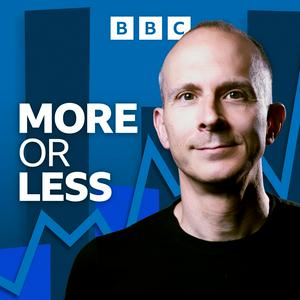
À propos de More or Less
Tim Harford explains - and sometimes debunks - the numbers and statistics used in political debate, the news and everyday life.
Site web du podcastÉcoutez More or Less, EX... ou d'autres podcasts du monde entier - avec l'app de radio.fr
Obtenez l’app radio.fr gratuite
- Ajout de radios et podcasts en favoris
- Diffusion via Wi-Fi ou Bluetooth
- Carplay & Android Auto compatibles
- Et encore plus de fonctionnalités
Obtenez l’app radio.fr gratuite
- Ajout de radios et podcasts en favoris
- Diffusion via Wi-Fi ou Bluetooth
- Carplay & Android Auto compatibles
- Et encore plus de fonctionnalités

More or Less
Scannez le code,
Téléchargez l’app,
Écoutez.
Téléchargez l’app,
Écoutez.
More or Less: Podcasts du groupe
 France