Écoutez gratuitement ce podcast dans l'application : Télécharger gratuitement dans l'App Store
radio.fr
Minuteur
Sauvegarde des favoris
148 épisodes
AI Adoption in Healthtech Marketing: What the 2026 Benchmark Reveals
19/10/2026 | 34 minYour team probably uses AI every day now. Can you show leadership what it’s actually getting you? For most healthtech marketing teams, the honest answer is no.
In this episode I share the results of the third wave of our AI benchmark survey of in-house healthtech marketers. In one year, the share of teams with integrated AI workflows or a strategic roadmap went from under a third to about two thirds, and nobody in the latest wave said they weren’t using AI at all. The data also shows three gaps. Only about 1 in 10 teams has AI fully connected to their CRM, CMS, or analytics. Four in 10 still aren’t measuring the return on AI. And 85 percent have no formal training budget.
My colleague Mark Erwich, Chief Strategy Officer at Health Launchpad, joins me to talk about what this means for you. We cover why “we use AI” no longer sets you apart and how to measure AI in a way that wins resources, not just one that justifies cost cuts. We also talk about how to think about the risk of connecting AI to your core systems. We share what happened when we presented the findings to the HealthTech Marketing Network, and we close with five practical takeaways you can act on this quarter.
Download the full report here.
Key Topics Covered
"(00:00)" Introduction
"(02:45)" Finding 1: AI maturity jumps from dabbling to building in one year
"(04:15)" Finding 2: Workflow integration vs. data integration with CRM, CMS, and analytics
"(06:00)" Finding 3: Measurement is the biggest blind spot
"(07:00)" Finding 4: Paid licenses are common, but training budgets and headcount are rare
"(08:15)" Finding 5: IT and engineering hold the keys to high-value use cases
"(09:00)" Why the measurement gap and the IT gap are two sides of the same coin
"(09:45)" Voices from the field
"(12:45)" The three phases of AI adoption
"(14:15)" Where differentiation comes from now
"(16:15)" Mark’s top recommendation
"(17:30)" Measuring AI by capability and quality first, efficiency last
"(21:15)" Why connecting AI to your data changes how you work
"(23:15)" What healthtech marketing leaders shared in the network session
"(25:00)" The risk question
"(27:45)" Other ways to connect AI to your systems besides APIs
"(28:15)" What marketing’s role looks like a year from now
"(30:30)" Mark’s one piece of advice
"(31:30)" Adam’s five takeaways from the survey
If you are interested in discussing this or any other topic, let's have a chat. Reach out to me directly to schedule a no-obligation discussion. This isn't a sales call, but rather an opportunity to talk through your questions and challenges.
Follow me on LinkedIn.
Subscribe to The Healthtech Marketing Show on Spotify or watch us on YouTube for more insights into marketing, AI, ABM, buyer journeys, and beyond!
Find all of our episodes on the Health Podcast Library.
Thank you to our presenting sponsor, HealthcareNOW, 24/7 expert shows, interviews, and podcasts, powering healthcare leaders with innovation, policy, and strategy insights.Planning Your 2027 Healthtech Events Calendar: What to Keep, What to Cut, and How to Stand Out
13/10/2026 | 47 minIf you run events in healthtech, this time of year means two full-time jobs: finishing 2026 and planning 2027. So I brought in people who do this every week.
Robin Moritz, Senior Event Manager at InterSystems, has run their trade show program for almost 20 years and handles around 60 events a year. Liat Kozuch, Field Marketing Lead at Hyro, runs more than 40 activations a year with a two-person team. My Health Launchpad colleague Amy Hamilton, a 20-year health IT veteran, joins me as co-host for the first time and leads most of the conversation.
We dig into the questions every event marketer is asking right now. How do you decide which shows to keep and which to cut? How soon can you judge whether an event worked? How do you stand out at HIMSS when Epic and Philips are next door? And how do you get people into your booth who actually matter to your sales team, not just a pile of badge scans that go nowhere?
Robin explains how InterSystems went from 85 shows to 60, and how hosting a reception at the College Football Hall of Fame turned a quiet show into one where people remembered them. Liat shares how she turns her booth into a "carnival" of micro-events, why she would rather take the stage alongside a health system customer than pitch alone, and how the Call Dropper game lets CIOs feel the exact pain Hyro solves. You will also get practical tools, low-budget booth ideas, and a strong case for putting marketers on the show floor.
If you are building your 2027 events calendar, this episode is a masterclass.
By the way, on Thursday, October 22, Hyro will host its third annual Care OnCue™ Summit, a free, one-day virtual event for health system leaders shaping the future of patient access and operations.
Across 20 sessions, more than 50 speakers from leading U.S. health systems, including AdventHealth, Sutter Health, Inova Health, UPMC, and Kaiser Permanente, will share what is working now and the practical lessons leaders should carry into their 2027 planning.
Can’t attend live? Register to receive access to the session recordings following the event.
Event and meeting tools
Jifflenow (Robin): Trade show meeting scheduling and analytics, now part of Cvent.
Popl (Robin): Event lead capture with badge scanning, AI data enrichment, and CRM sync.
Salesforce and HubSpot (Robin): The CRMs she mentioned integrating with Jifflenow.
Planning and project management
monday.com (Robin, Amy, Liat): Cloud-based work management platform.
monday.com connector for Claude (Liat): The setup Liat described for turning voice notes into Monday tasks and briefs. The connector is based on monday MCP, uses OAuth authentication, and respects existing monday.com permissions.
Miro (Liat): The visual whiteboard she uses to map the full event calendar.
Events and venues mentioned
HIMSS Global Health Conference (Robin, Liat)
ViVE (Liat)
CHIME Fall Forum (Liat)
Becker's Healthcare events (Liat)
Civitas Networks for Health Annual Conference (Robin)
College Football Hall of Fame (Robin's Civitas reception venue)
Sphere, Las Vegas (Robin's pre-HIMSS event)
Swaay Health / Swaay Live (Amy)
Guest companies and resources
Patient Journey Pioneers (Liat's podcast): Hyro's podcast featuring insights from leading healthcare executives on emerging techn, digital acceleration, and patient journey strategy.
Hyro Care OnCue™ Summit (Oct 22)
If you are interested in discussing this or any other topic, let's have a chat. Reach out to me directly to schedule a no-obligation discussion. This isn't a sales call, but rather an opportunity to talk through your questions and challenges.
Follow me on LinkedIn.
Subscribe on Spotify or watch us on YouTube for more insights into marketing, AI, ABM, buyer journeys, and beyond!
All of our episodes the Health Podcast Library.
Thank you to our presenting sponsor, HealthcareNOW, 24/7 expert shows, interviews, and podcasts, powering healthcare leaders with innovation, policy, and strategy insights.Thought Participation: Why Most Healthtech Thought Leadership Isn't Leadership
05/10/2026 | 28 minMost healthtech thought leadership isn't leadership. It's participation with a byline. That's what healthtech marketing leaders are saying about themselves.
This month we ran two candid peer sessions on thought leadership in the Healthtech Marketing Network, and this solo episode is my report on what came out of them. When we asked senior marketing leaders where their programs sit on Adrianna Hosford's three levels of thought leadership, almost everyone said level two. A few said zero. Not one person claimed level three, even though industry surveys say 97% of practitioners believe their programs deliver measurable impact.
I walk through six themes from those conversations. Why evidence alone is not a point of view. Why the bar for bold is lower in healthcare than you think. Why your best thought leader might be a director, a clinician, or a KOL rather than your CEO. How AI went from a bad author to your most important reader. Why the stage is the source and everything else is the echo. And why the attribution ceiling is starting to crack. Along the way I bring in insights from past guests Adrianna Hosford, Paul Wicks, and John Lynn, and I close with five takeaways and one exercise you can try this week.
If you've ever wondered whether your thought leadership actually sets you apart or just adds to the noise, this episode will help you find out.
Key Topics Covered:
"(00:00)" Introduction
"(03:10)" Adrianna Hosford's three levels of thought leadership
"(06:00)" The level two trap: free education for your whole category
"(07:00)" Evidence is not a point of view
"(08:45)" Two CEOs who paired proof with a real opinion
"(10:10)" Regulatory constraints and healthcare's lower bar of controversy
"(12:25)" KOLs as third-party endorsement
"(13:25)" Building thought leadership for buying committees
"(15:05)" AI as author: why it produces the generic average
"(17:00)" AI as audience: what LLMs weigh when deciding who gets cited
"(18:10)" John Lynn's counterpoint on branded content and AI citations
"(19:25)" Why conferences and live events came out on top
"(20:15)" Why the room was skeptical of LinkedIn despite the ROI data
"(21:20)" Podcasting as the bridge between the live moment and the long tail
"(22:30)" Can thought leadership be tied to pipeline?
"(25:25)" Five key takeaways
"(27:05)" One thing to try this week
"(27:25)" Closing thoughts
Previous Episodes Mentioned:
Is Sponsored Media as Trusted as Earned Media?
The Thought Leadership Gap in Healthtech
How to Build Pipeline With Podcasts
How Peer-Reviewed Evidence Drives AI Discoverability
Resources Mentioned:
Thought Leadership in Practice: The 2026 Report
The ROI of Thought Leadership: Calculating the Value that Sets Organizations Apart
If you are interested in discussing this or any other topic, let's have a chat. Reach out to me directly to schedule a no-obligation discussion. This isn't a sales call, but rather an opportunity to talk through your questions and challenges.
Follow me on LinkedIn.
Subscribe to The Healthtech Marketing Show on Spotify or watch us on YouTube for more insights into marketing, AI, ABM, buyer journeys, and beyond!
Find all of our episodes on the Health Podcast Library.
Thank you to our presenting sponsor, HealthcareNOW, 24/7 expert shows, interviews, and podcasts, powering healthcare leaders with innovation, policy, and strategy insights.How to Choose the Right Paid Media Playbook for Healthtech
28/09/2026 | 34 minHow do you know whether your healthtech company needs a classic demand gen campaign or a full ABM program?
In this episode, I'm joined by my colleague Paul Vandre, Account Director and Digital Marketing Specialist at Health Launchpad. Paul has two decades of experience in digital marketing, spending more than five years building paid media strategy for about 30 Health Launchpad clients.
Paul starts by diagnosing the right approach. He uses two rules of thumb: a deal size of around $50K, and who you're selling to. Then he looks at why health systems usually settle on a shortlist long before anyone books a demo. According to 6sense, the first vendor a buyer calls wins 84% of the time, so paid media's real job is getting you into the consideration set early. Paul also explains which signals to track at each stage of the buyer journey, and how to show your leadership team that marketing is influencing revenue when you can't attribute every deal.
On the demand gen side, Paul gets into why LinkedIn isn't always the answer, especially for clinician audiences. Paul explains how Meta, programmatic, Google, direct mail, and niche trade outlets fit into a real multi-channel mix. He also covers why campaigns tend to hit their stride around month three. If your paid media isn't delivering what you expected, this episode will help you work out whether the problem is your channels, your message, or both.
Key Topics Covered
"(00:00)" Introduction
"(04:00)" How to tell whether a company needs demand gen or ABM
"(06:00)" Two rules of thumb: the $50K deal size line and who you sell to
"(07:00)" How health systems buy and how paid media supports ABM
"(10:00)" The 6sense stat: the first vendor called wins 84% of the time
"(11:00)" What digital advertising is for
"(13:00)" The signals to track at each buyer stage
"(14:00)" Showing leadership the value of influence
"(19:00)" Reaching clinicians when LinkedIn doesn't work
"(21:00)" What to expect in the first three months of a paid demand gen campaign
"(23:00)" Programmatic advertising explained
"(26:00)" Content and offers that work at each stage of the funnel
"(28:00)" Paul's biggest lesson
"(30:00)" The first thing to check when paid media isn't working
"(32:00)" My five key takeaways from the conversation
If you are interested in discussing this or any other topic, let's have a chat. Reach out to me directly to schedule a no-obligation discussion. This isn't a sales call, but rather an opportunity to talk through your questions and challenges.
Follow me on LinkedIn.
Subscribe to The Healthtech Marketing Show on Spotify or watch us on YouTube for more insights into marketing, AI, ABM, buyer journeys, and beyond!
Find all of our episodes on the Health Podcast Library.
Thank you to our presenting sponsor, HealthcareNOW, 24/7 expert shows, interviews, and podcasts, powering healthcare leaders with innovation, policy, and strategy insights.Why Buyers Stopped Believing Your ROI Story and Other Big Issues in 2026
21/09/2026 | 34 minIf you skipped every healthtech conference this year, this episode is your catch-up call.
My guest is Colin Hung, Editor-in-Chief at Swaay.Health and Healthcare IT Today, who is on pace to attend 50 conferences in 2026, roughly one a week, which means he sees more vendor pitches and more buyer conversations than almost anyone else in this industry. I asked him what has actually changed on the show floor this year, and his answer should worry anyone still pitching a five-year ROI story.
Colin walks me through why buyers have no patience for long payback periods. The standard or many, is three to six months. And, why AI has quietly moved from a standalone purchase to something baked into every backend system you already own. That shift is making it harder than ever for vendors to stand out.
We get into the one unglamorous AI use case that is actually winning deals right now (hint: it involves faxes), why security transparency and AI governance are becoming the next competitive edge, and what he thinks marketers need to stop saying if they want their message to break through the noise.
We close with his predictions for 2027, including a call on patient experience investment that you may not want to hear, and his take on what you are missing every single time you decide to stay home instead of showing up.
Key Topics Covered
“(00:00)” – Introduction
“(06:00)” – The economy takes center stage in conversations
“(08:00)” – Budget cuts, paused projects, and stripped down requirements
“(09:00)” – Buyers now demand proof of value in three to six months
“(10:00)” – Operational efficiency becomes the new buzzword
“(12:00)” – A maturing conversation around generative versus agentic AI
“(17:00)” – Fax triage and other unglamorous, high impact AI deployments
“(19:00)” – The gap between what vendors promote and what buyers want
“(23:00)” – Security transparency and AI governance are becoming competitive advantages
“(24:00)” – The standout technology of the year
“(26:00)” – Predictions for 2027
“(29:00)” – What healthtech marketers miss by skipping conferences entirely
“(30:00)” – What's next for Swaay.Health
If you are interested in discussing this or any other topic, let's have a chat. Reach out to me directly to schedule a no-obligation discussion. This isn't a sales call, but rather an opportunity to talk through your questions and challenges.
Follow me on LinkedIn.
Subscribe to The Healthtech Marketing Show on Spotify or watch us on YouTube for more insights into marketing, AI, ABM, buyer journeys, and beyond!
Find all of our episodes on the Health Podcast Library.
Thank you to our presenting sponsor, HealthcareNOW, 24/7 expert shows, interviews, and podcasts, powering healthcare leaders with innovation, policy, and strategy insights.
Plus de podcasts Technologies









Podcasts tendance de Technologies













À propos de The Healthtech Marketing Show
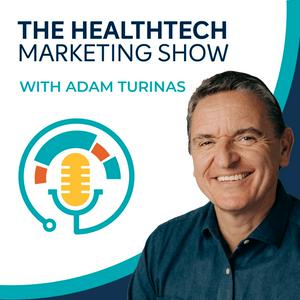
Marketing to healthcare is hard. We can all use a little help. Join us for The Healthtech Marketing Show to learn from the experts.
Each episode features an experienced healthcare technology marketing leader who shares tips, insights, and how-to’s on a specific topic. Episodes include ABM, brand strategy, digital and content marketing, and more. The series is presented by Adam Turinas, a marketing veteran and health tech entrepreneur.
The show is presented by Health Launchpad in partnership with Healthcare NOW Radio.
640646
Site web du podcastÉcoutez The Healthtech Marketing Show, Underscore_ ou d'autres podcasts du monde entier - avec l'app de radio.fr
Obtenez l’app radio.fr gratuite
- Ajout de radios et podcasts en favoris
- Diffusion via Wi-Fi ou Bluetooth
- Carplay & Android Auto compatibles
- Et encore plus de fonctionnalités
Obtenez l’app radio.fr gratuite
- Ajout de radios et podcasts en favoris
- Diffusion via Wi-Fi ou Bluetooth
- Carplay & Android Auto compatibles
- Et encore plus de fonctionnalités
The Healthtech Marketing Show
Scannez le code,
Téléchargez l’app,
Écoutez.
Téléchargez l’app,
Écoutez.
 France