Écoutez gratuitement ce podcast dans l'application : Télécharger gratuitement dans l'App Store
radio.fr
Minuteur
Sauvegarde des favoris
Tech, Innovation & Society - The Creative Process: Technology, AI, Software, Future, Economy, Science, Engineering & Robotics Interviews
Technology, AI, Software, Future, Economy, Science, Engineering & Robotics Interviews - Creative Process Original Series
Dernier épisode
299 épisodes
AI, Robotics, VR, Bio-plastics: LINCOLN CENTER’S Shanta Thake on the Power of Performing Arts in the Age of AI - Highlights
19/08/2026 | 18 min"I really do believe that the arts are critical to how we move forward together, and live performance in particular, I think, is a way of us practicing how to move across our ideological boundaries and find one another and imagine these new worlds together and create together."
Shanta Thake is the Chief Artistic Officer at Lincoln Center for the Performing Arts—the nation's largest performing arts complex. Before stepping into this role, she spent nineteen years at The Public Theater, shaping the city's cultural landscape through Joe's Pub and expansive community initiatives. Today, she is tearing down walls—both the literal barriers separating Lincoln Center from its neighbors, and the figurative ones that dictate who belongs in our cultural spaces. She views the arts not as a luxury, but as essential civic infrastructure. We are pleased to have Shanta Thake to discuss her journey, the power of radical curation, and the future of public performance.
(00:01) Art as the Oldest Technology
(07:50) The Gift of Pause
(09:55) Reimagining Lincoln Center
(12:19) A Collective Caretaking
(12:56) The Curiosity of Childhood
(18:02) San Juan Hill and The Wall
(20:39) globalFEST: Music and Connection
Episode Website
www.creativeprocess.info/pod
Instagram:@creativeprocesspodcastFake Corridors: Surviving the Labyrinth of Social Media & Disinformation - Highlights
07/08/2026 | 26 minToday, we have a conversation about time, memory, and the bittersweet geography of human sorrow. Georgi Gospodinovis widely considered one of the most daring voices in contemporary European literature. His acclaimed novel, The Physics of Sorrow, won the prestigious Jan Michalski Prize in 2016, blending ancient myth and quantum physics to chronicle the delicate realities of post-socialist Eastern Europe. Joining him is Angela Rodel, a brilliant linguist, musician, and translator whose profound artistic empathy carries the flowing cadences of the Bulgarian language into vivid English. Together, this extraordinary creative duo made history by winning the 2023 International Booker Prizefor Time Shelter—the first book written in Bulgarian to ever receive the honor.
Time Shelter is a masterfully dark, funny, and prescient novel. It begins with an enigmatic psychiatrist opening a clinic that treats Alzheimer’s patients by meticulously recreating past decades to match their internal clocks. But the experiment quickly escapes the clinic walls, triggering a pan-European crisis where entire nations hold democratic referendums to choose which era of the past they will retreat into. It is a book that holds up a mirror to our own world, exploring what happens when a civilization faces a deficit of meaning and tries to weaponize nostalgia.
(0:00) The Trap of Nostalgia
(1:22) The Nonlinear Approach to Storytelling
(3:53) Translating the Atmosphere
(4:31) The Pandemic of the Past
(6:37) Death and the Gardener
(9:49) The Translators Calling
(11:00) Slowing Down Time
(13:14) Storytelling vs Propaganda
(15:54) Translating the Atmosphere
(18:19) What makes a good life? What has given your life meaning?
(20:56) Reflections on God and the Stories His Grandmother Told Him
(23:43) The Importance of Hugging, Empathy and Storytelling
Episode Website
www.creativeprocess.info/pod
Instagram:@creativeprocesspodcastReclaiming the Human Circuit: Bio-Tech, Interactive Art, and Society w/ LINCOLN CENTER’S SHANTA THAKE
03/08/2026 | 57 min“Lincoln Center is multiple stages. I think probably over three dozen stages across 16 acres. It is a vast canvas in and of itself. And then we have this beautiful plaza that leads to this beautiful campus, and that’s the visual I think that most people have when they think of Lincoln Center is this beautiful fountain in the center and these three gorgeous buildings.It’s New York’s biggest plaza, and it feels very vibrant and beautiful. In the summer, we really take that plaza and we transform it into a dance floor. So this idea of also interrupting what people’s notion of Lincoln Center is because it’s a space that is very aspirational, which is a great thing.”
Shanta Thake is the Chief Artistic Officer at Lincoln Center for the Performing Arts—the nation's largest performing arts complex. Before stepping into this role, she spent nineteen years at The Public Theater, shaping the city's cultural landscape through Joe's Pub and expansive community initiatives. Today, she is tearing down walls—both the literal barriers separating Lincoln Center from its neighbors, and the figurative ones that dictate who belongs in our cultural spaces. She views the arts not as a luxury, but as essential civic infrastructure. We are pleased to have Shanta Thake to discuss her journey, the power of radical curation, and the future of public performance.
(0:00) Reimagining Lincoln Center
(2:27) Art and the Human Experience
(4:40) The Curiosity of Childhood
(5:44) Alvin Ailey and the Pivot
(8:29) The Invisible Arts
(9:06) The Power of Public Theater
(17:03) Curation, Programming and the Art of Listening
(23:42) San Juan Hill and The Wall
(31:23) Art as the Oldest Technology
(35:02) globalFEST: Music and Connection
(38:20) Finding Universal Belonging
(41:20) The Gift of Pause
(54:27) A Collective Caretaking
Episode Website
www.creativeprocess.info/pod
Instagram:@creativeprocesspodcastThe $7.5 Trillion Gamble on AI Domination & The Future of Humanity w/ NACHO DE GREGORIO
10/07/2026 | 1 h 43 minFor over a decade, technology has promised to make life easier. Social media was meant to connect us, we were told smartphones would simplify our lives, and now artificial intelligence promises to lift even more daily burdens. Yet these advances also raise an important question: when do tools enhance human creativity, and when do they replace the very experiences that give life meaning? While AI holds immense promise, many people face challenges coping with current technological advancements that ‘redefine’ human communication, work, education, and democratic values. Today, we examine societal and cultural impacts of AI, identity, inclusion, governance, education, and community well-being. And are speaking with Nacho de Gregorio, author of TheWhiteBox, one of Medium's most-followed AI analysts, for a level-headed conversation about both the remarkable potential and the real limitations of AI.
(0:00) The AI compute gap and national security
(1:56) The hidden risks of the AI debt bubble
(4:40) Separating AI hype from job displacements
(12:38) Shadow borrowing and the data center boom
(17:19) Europe's missing infrastructure and tech sovereignty
(21:52) The Jevons paradox and the demand for compute
(26:37) Regulatory capture and doomerism
(31:12) Why open source AI is the best path forward
(42:19) The chess paradox and the future of human art
(46:35) Unmeasurable domains and future-proofing your career
(53:45) Tutoring and AI in education
(1:01:48) Navigating the AI slop and information ecosystem
(1:16:00) Finding beauty in the natural world
(1:20:18) The pleasure of waiting vs. the hustle
(1:35:01) Setting healthy boundaries with technology
Episode Website
www.creativeprocess.info/pod
Instagram:@creativeprocesspodcastSurviving the AI Hype Cycle Without Losing Your Mind (or Your Job) w/ NACHO DE GREGORIO - Highlights
09/07/2026 | 17 min“ I'm a believer in this technology. I believe that the cheaper it is, the more people will use it. So, even if we assume that models will get smaller for the same level of intelligence, the demand to actually have more compute is going to be enormous. And the reason why you want to have the, the compute close to you is not only in terms of performance. As a national security threat, I'm not saying this will happen, but it could happen that, China or US or whoever decides to stop exporting compute to the rest of the world. If that happens today, Europe has zero AI at the scale of data the data center.”
For over a decade, technology has promised to make life easier. Social media was meant to connect us, we were told smartphones would simplify our lives, and now artificial intelligence promises to lift even more daily burdens. Yet these advances also raise an important question: when do tools enhance human creativity, and when do they replace the very experiences that give life meaning? While AI holds immense promise, many people face challenges coping with current technological advancements that ‘redefine’ human communication, work, education, and democratic values. Today, we examine societal and cultural impacts of AI, identity, inclusion, governance, education, and community well-being. And are speaking with Nacho de Gregorio, author of TheWhiteBox, one of Medium's most-followed AI analysts, for a level-headed conversation about both the remarkable potential and the real limitations of AI.
(0:22) The hidden risks of the AI debt bubble
(0:55) Shadow borrowing and the data center boom
(3:12) The AI compute gap and national security
(5:40) Europe's missing infrastructure and tech sovereignty
(8:13) The Jevons paradox and the demand for compute
(10:25) Why open source AI is the best path forward
(12:31) The chess paradox and the future of human art
(12:53) Unmeasurable domains and future-proofing your career
(14:00) Tutoring and AI in education
(15:11) Navigating AI slop and the information ecosystem
(16:24) The Pleasure of Waiting vs. The Hustle
Episode Website
www.creativeprocess.info/pod
Instagram:@creativeprocesspodcast
Plus de podcasts Culture et société








Podcasts tendance de Culture et société


















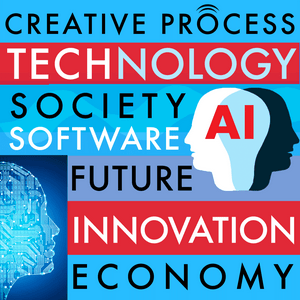
À propos de Tech, Innovation & Society - The Creative Process: Technology, AI, Software, Future, Economy, Science, Engineering & Robotics Interviews
Rethinking tomorrow. We focus on technology, innovation, society, AI, science, engineering, the economy & issues facing people & the planet. Leading thinkers, organizations & environmentalists discuss technology, creativity & pathways for a more sustainable future.
Exploring the fascinating minds of creative people. Conversations with writers, artists & creative thinkers across the Arts & STEM. We discuss their life, work & artistic practice. Winners of Oscar, Emmy, Tony, Pulitzer, leaders & public figures share real experiences & offer valuable insights. Notable guests and participating museums and organizations include: Academy of Motion Picture Arts & Sciences, Neil Patrick Harris, Smithsonian, Roxane Gay, Musée Picasso, EARTHDAY.ORG, Neil Gaiman, UNESCO, Joyce Carol Oates, Mark Seliger, Acropolis Museum, Hilary Mantel, Songwriters Hall of Fame, George Saunders, The New Museum, Lemony Snicket, Pritzker Architecture Prize, Hans-Ulrich Obrist, Serpentine Galleries, Joe Mantegna, PETA, Greenpeace, EPA, Morgan Library & Museum, and many others.
The interviews are hosted by founder and creative educator Mia Funk with the participation of students, universities, and collaborators from around the world. These conversations are also part of our traveling exhibition.
www.onplanetpodcast.org
www.creativeprocess.infowww.oneplanetpodcast.org
Interviews conducted by artist, activist, and educator Mia Funk with the participation of students and universities around the world.
INSTAGRAM @creativeprocesspodcast
INSTAGRAM @oneplanetpodcast
Site web du podcastÉcoutez Tech, Innovation & Society - The Creative Process: Technology, AI, Software, Future, Economy, Science, Engineering & Robotics Interviews, Un mot par jour ou d'autres podcasts du monde entier - avec l'app de radio.fr
Obtenez l’app radio.fr gratuite
- Ajout de radios et podcasts en favoris
- Diffusion via Wi-Fi ou Bluetooth
- Carplay & Android Auto compatibles
- Et encore plus de fonctionnalités
Obtenez l’app radio.fr gratuite
- Ajout de radios et podcasts en favoris
- Diffusion via Wi-Fi ou Bluetooth
- Carplay & Android Auto compatibles
- Et encore plus de fonctionnalités
Tech, Innovation & Society - The Creative Process: Technology, AI, Software, Future, Economy, Science, Engineering & Robotics Interviews
Scannez le code,
Téléchargez l’app,
Écoutez.
Téléchargez l’app,
Écoutez.
 France